BLOG · PLANNING
Can I Do a Partial Camino Instead of the Full Route?
- TopicPlanning
- Reading time6 min
- Sections insideLeón to Finisterre · Porto to Santiago · SJPP to León
- Our total≈ 1,877 km walked
Short answer: yes. There is no rule that a Camino only counts if you walk every kilometre of a route from its traditional starting point. Of our eight caminos, some were sections - a stretch chosen for the time we had, the season, and the walking we most wanted to do. Together those sections add up to about 1,877 km of trail, and we have never once felt we were doing half a Camino. Half a camino, it turns out, is still a lot of walking.
Here is how to think about walking part of a route, based on what has actually worked for us.
Everything in this post comes from our own caminos - our stage notes, our bookings and our photos. If we did not walk it or live it, it is not in here.
Why pilgrims walk a section
- Time. The full Camino Frances from Saint-Jean-Pied-de-Port is about 780 km - five weeks or more of walking. Five weeks away is a big ask for most people. A section turns an impossible trip into a possible one.
- A first taste. 7-10 days is enough to learn whether the Camino is for you. Plenty of pilgrims start with a week or so, then come back for the next section, year after year, until the route is done.
- Going back to the good part. Once you know a route, you can return to the stretch you loved and skip the stretch you did not. The good part will still be there - and it is usually just as good the second time around.
- Honest legs. A section lets you walk at a pace your body enjoys instead of racing a calendar. That matters more with every decade. We can confirm.
Does a partial Camino still “count”?
Yes, with one point to understand if the Compostela - the certificate issued in Santiago - matters to you. To receive it, you need to walk at least the last 100 km into Santiago on a recognised route, collecting stamps in your credencial (pilgrim passport) along the way - two stamps a day is the custom in that final stretch. The classic starts for that are Sarria on the Camino Frances (about 115 km out) and Tui on the Camino Portugues (about 115 km out).
If you walk a section that does not end in Santiago, there is no certificate - and many of our best walks have ended somewhere else entirely. Our next camino, in autumn 2027, stops in Leon, roughly halfway along the Frances. Nobody is awarding anything in Leon. We are going because that is the walk we want.
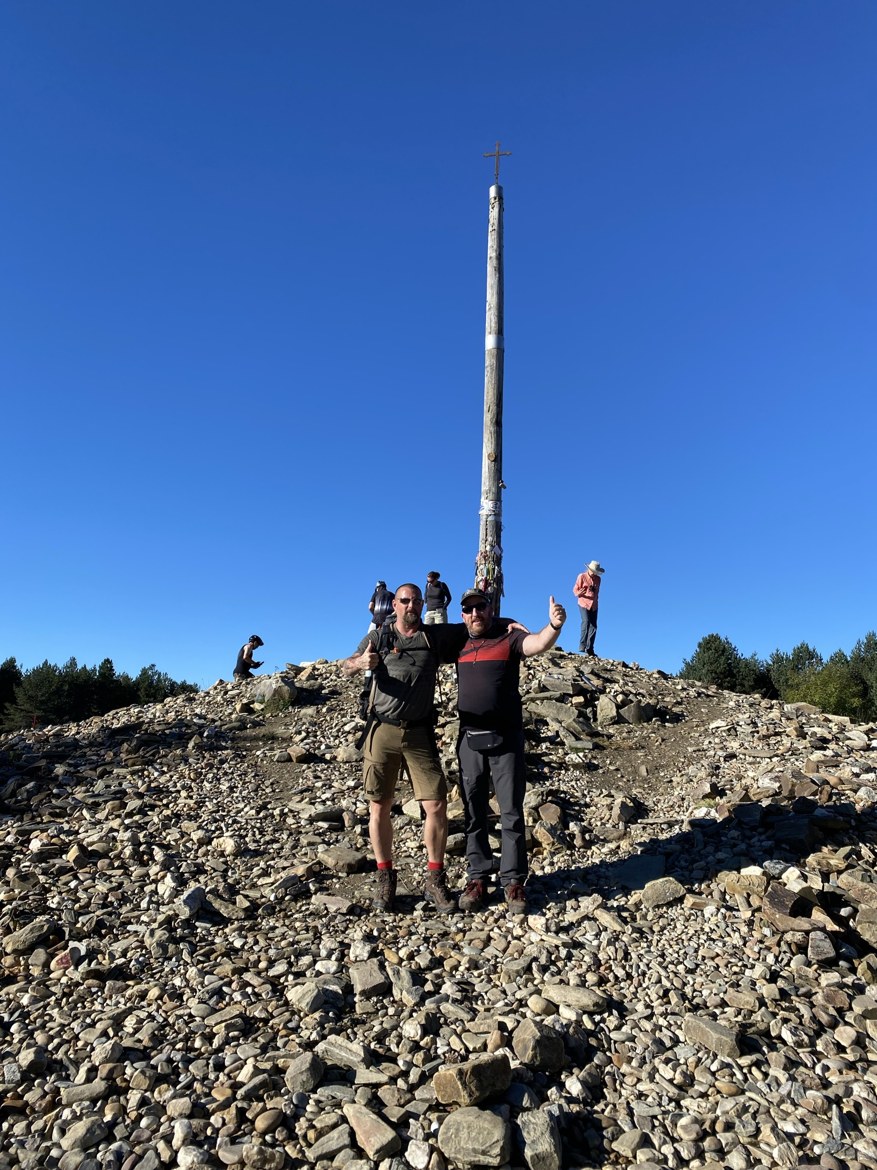
And a section that skips a middle piece is legitimate too. On our second camino in 2021 we walked from Leon to Sarria - about 197 km over seven days, over the Cruz de Ferro and up to O Cebreiro - then took a bus to Santiago and walked on to Finisterre, another 88 km. About 285 km on foot in all. We skipped Sarria to Santiago on purpose. We had already walked into Santiago together once, in 2019, coming from Porto. This time the finish we wanted was Finisterre. The bus was not a defeat. It was a bus.
How to choose where to start and stop
1. Start with your days, not the map. Count your walking days honestly, then take off a day at each end for travel, and one rest day for every week you will walk. What is left is your walk. Roughly:
- 5-6 walking days at 20-25 km a day: about 100-120 km - a Sarria or Tui start
- 8-10 walking days: about 180-220 km - Leon to Sarria, or Ponferrada to Santiago
- 13-15 walking days: about 260-300 km - Porto to Santiago, the Portugues as most pilgrims walk it, and how we started in 2019
- 19-21 walking days: about 450-480 km - Saint-Jean-Pied-de-Port to Leon, our 2027 plan
2. Start and finish at places you can actually reach. The good section towns sit on train or bus lines: Pamplona, Burgos and Leon on the Frances; Ponferrada and Sarria further west; Tui and Vigo on the Portugues. A beautiful finish in a village with one bus a day will cost you a travel day - price it in before you choose it.
3. Decide whether Santiago is your ending. Ending in Santiago gives you the cathedral, the pilgrim mass and, if you qualified, the Compostela. Ending somewhere else gives you a quieter finish and a reason to come back. Neither is better. They are different trips.
4. Keep the best walking inside your section. Pick the best walking, not the most walking. Ten days is enough for the mountains around the Cruz de Ferro - skip the extra flat kilometres. Choose the stretch you will still be talking about in five years. We are - the walk we met on, in Portugal in 2019, is still the one we talk about most.
You can also change your mind mid-walk
A plan is a starting point, not a contract. In 2025 we set out on the Camino del Norte from Irun, walked two days to Zarautz, and then changed the whole trip. The Norte's start had let us down - too expensive, and in July more beach holiday than pilgrim trail (post 4 tells that story properly). So: by train to Ponferrada, and we walked the Frances from there into Santiago, about 246 km in total. It was not the camino we had planned. It ended as one of our favourites. Plans are like that.
Mistakes to avoid
- Starting too far back for your days. This is the common one. It turns a pilgrimage into a race, and your feet will not appreciate it by day 4.
- Forgetting the travel days. Canada to the start of a trail can be two days, each way. However you get to the start of the trail, count the getting there.
- No rest day in the math. Build it in on paper and you can always walk it if you feel strong. Leave it out on paper and your body will take it anyway, in a worse place.
- Apologising for walking a section. There is no need. You will meet pilgrims walking a week, a month, and everything in between, and nobody on the trail asks to see your full itinerary before they share a table with you.
The honest summary
A partial Camino is not half an experience. Take our first walk together, in 2019: Porto to Santiago, two weeks. Draw the Portugues all the way back to Lisbon, as some do, and Porto is a section of it. Start it in Porto, as most pilgrims do, and it is the whole route. We have never bothered settling which label it gets, because the label is not the experience: by the second night 2 German brothers I had never met were walking with me, a Canadian. Seven years and eight caminos later, we still talk almost every day. Call it partial if you like. Nothing about it felt partial.
Walk the part you can walk. It is enough - and if it is not, the rest of the route will still be there next year. It has waited eight centuries; it will wait for you too.
From the trail to the page
These posts are the tidy lessons. The book is where they came from. Buen Camino, Brother: A WhatsApp Story is built from our WhatsApp messages - Mike in Canada, Nicki in Germany, planning in real time since 2019. Choosing routes and dates, settling daily distances, booking beds, changing plans mid-walk. The ups: eight caminos across Spain, Portugal, Germany and Austria. The downs: illness, a clinic visit, two pandemic years apart - and ordinary life between the walks, the hard parts and the good parts. And underneath it all, a friendship that started between strangers in 2019 and is still going almost every day. Learn from the real planning, not just the polished advice.
Coming January 2027. Join Camino Dispatches
Walking your own Camino? Keep the journal as you go. I built Townstamp after eight caminos of wishing for exactly this: every entry stamped with the town and the date, photos kept with the words, and a book-style PDF of the whole trip when you get home. Townstamp